Compensation Failure as the Mechanism of Psychosis in 22q11.2 Deletion Syndrome: A Falsifiable Model
Department of Psychiatry, Perelman School of Medicine, University of Pennsylvania; Lifespan Brain Institute, Penn Medicine and Children's Hospital of Philadelphia
Download PDF manuscript and supplemental material, one file
Abstract
The 22q11.2 deletion raises psychosis risk roughly twentyfold, yet most carriers never become psychotic. That gap, rather than the deletion's biology, is what a theory of this syndrome has to explain, and most of the cellular literature cannot address it: it compares carriers who have schizophrenia with healthy controls, so what it identifies belongs to the combined deletion-and-illness group and cannot be assigned to the deletion alone. This article proposes that the deleted genes with demonstrated neural phenotypes are dosage-limiting for rates, gains and throughputs rather than for structures, so that hemizygosity narrows the range over which a controlled variable can be corrected. The predicted phenotype is bidirectional instability of set points, which is what is observed: connectivity is in surplus before puberty and in deficit after it in deletion mice and in carriers; synaptic transcripts rise while presynaptic proteins fall; neurons are more excitable while their evoked calcium transients are smaller. The model holds that every carrier compensates, and states itself in six separately defined quantities, each with a proposed measurement or proxy: demand, intrinsic capacity, effort, effective capacity, output and reserve. Its predictions can therefore differ in sign between quantities and cannot be averaged into one. Psychosis is placed where the rising demand of adolescent remodeling crosses a falling capacity, with the timing set by regulatory trajectories. The sharpest consequence inverts the usual case-control logic: on compensatory effort the protected carrier should be abnormal beyond controls rather than normal, and the one cellular study to have measured compensatory-effort variables in carriers with and without schizophrenia reports that ordering. Because the state is an imbalance rather than accumulated damage, positive symptoms should remit while negative symptoms and functional impairment persist, and they do. Dopamine is placed as a downstream compensator with a perceptual cost rather than a final common pathway. Four prespecified programs state what would falsify the model, with evidence for, evidence against, and inconclusive outcomes defined in advance.
Keywords: 22q11.2 deletion syndrome, psychosis, incomplete penetrance, compensation, developmental dysconnectivity, falsifiability
1The Central Claim
1.1The question the syndrome can answer
The 22q11.2 deletion is the most informative natural experiment in psychiatric genetics, and the field has largely used it to answer a different question from the one it is best placed to answer. Carriers of the recurrent hemizygous deletion face a risk of psychotic illness some twentyfold above the population rate (Khan et al., 2020; McDonald-McGinn et al., 2015; Murphy et al., 1999). The 3-Mb form, in roughly 85 to 90% of cases, removes one copy of some 46 protein-coding genes; the nested 1.5-Mb form, in most of the remainder, removes about 28 to 30. About a quarter of carriers develop a schizophrenia-spectrum disorder by young adulthood (Gur et al., 2023), and 41% of those older than 25 in the International Brain and Behavior Consortium sample met criteria for a psychotic disorder (Schneider et al., 2014). The lesion is known in advance; the outcome is not. The scientific value of the syndrome lies in that discrepancy: it converts an intractable question about why some people develop psychosis into a tractable question about why some carriers of a specified lesion do.
Most of the cellular and molecular literature cannot answer that question, because of how its comparisons are built. Patient-derived neurons, organoids, fibroblasts and barrier models are overwhelmingly drawn from carriers who have schizophrenia and compared with cells from people who have neither the deletion nor the illness (Crockett et al., 2021; Li et al., 2019; Rao et al., 2025). A difference in that contrast is attributable to the deletion, to the illness, to medication, or to their combination, and the design cannot apportion it. Such studies identify abnormalities of the combined deletion-and-illness group; what distinguishes the carrier who becomes psychotic from the one who does not, they cannot establish. This article proposes a model built from the penetrance question outward, and states what would refute it.
1.2The claim, and the quantities it is stated in
The central claim is that the 22q11.2 deletion does not install a psychosis-producing lesion; it narrows the dynamic range of the regulatory systems that hold cortical circuits at their set points, and psychosis occurs in the minority of carriers in whom the rising demand of adolescent remodeling crosses a falling compensatory capacity. The deleted genes that carry demonstrated neural phenotypes are dosage-limiting for a rate, a gain or a throughput rather than for the existence of a structure (Section 3). That is a claim about which of a gene's functions the second copy is required for, not a taxonomy sorting genes into regulators and effectors. The model's hypothesis, tested as such in Section 11 rather than entailed by reduced dosage, is that losing one copy narrows the range over which deviations can be corrected, so the phenotype is an instability of set points rather than a deficit of fixed size: bidirectional, sign-changing across development, and revealed under load.
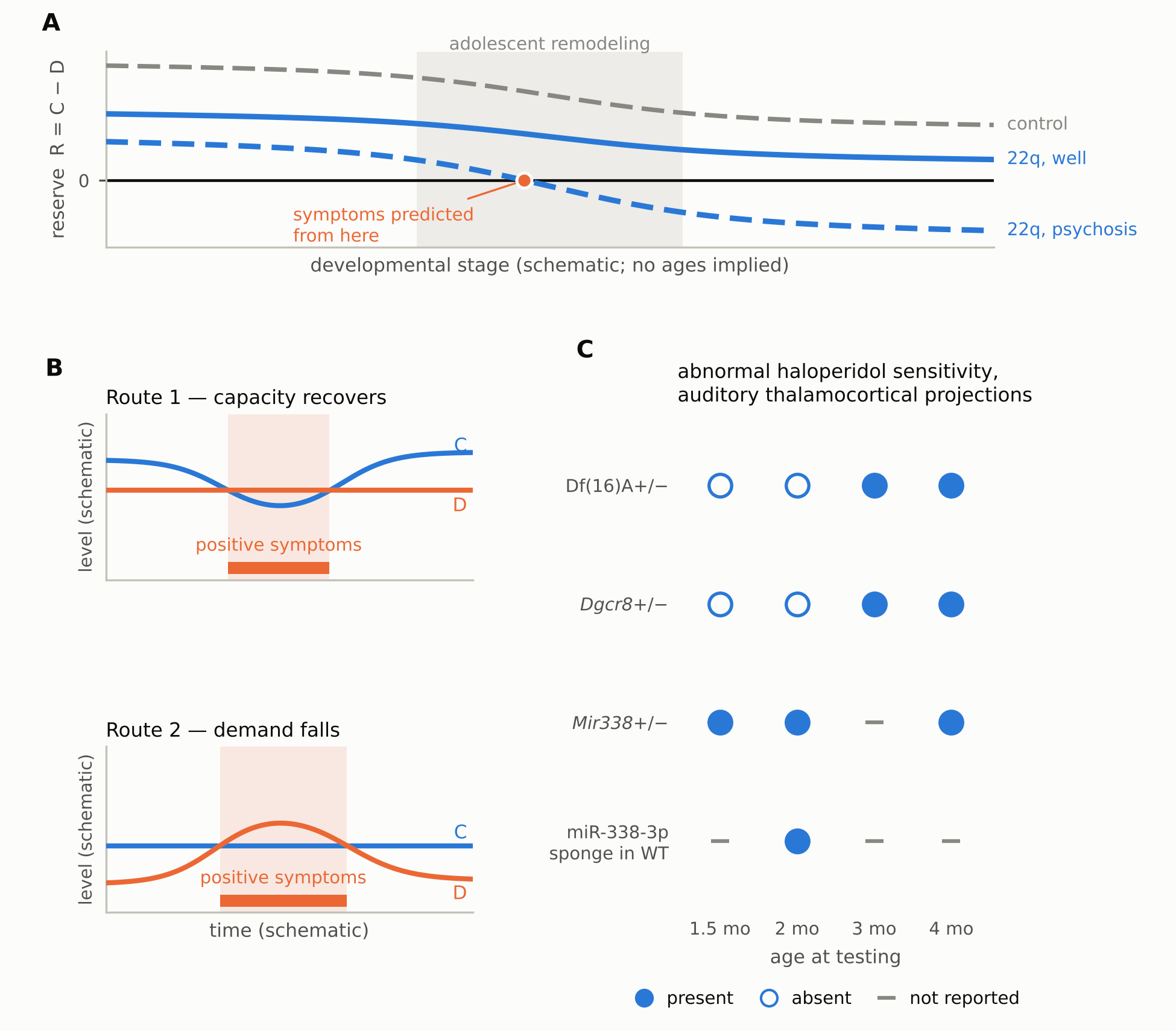
A model of reserve is unfalsifiable unless its terms are distinct and separately predicted. The model is therefore stated in six quantities, and Table 1 fixes for each what it is, how it would be measured, and what it is predicted to do in every group. Demand, D, is the rate at which a circuit requires its regulated variable, synaptic maintenance as specified in Section 5, to be supplied. Intrinsic capacity, C₀, is the maximal rate at which that process can run from gene dosage alone; it is identified from effective capacity with effort held at control level rather than measured directly, and it is the quantity predicted to vary monotonically with copy number. Compensatory effort, E, is the regulatory response recruited to close the gap. Effective capacity, C, is intrinsic capacity raised by effort with diminishing returns, which is the ceiling the model is named for. Output, O, is the maintained function, and reserve, R = C − D, is the margin by which it is maintained. Figure 1A plots that margin directly for the three groups, so that the model's threshold is the zero line and the transition into psychosis is predicted where a trajectory crosses it.
Demand is not constant across genotypes, and the model's arithmetic requires that it is not. With equal demand, a carrier whose effective capacity exceeded a control's would have the larger reserve, which is the reverse of what this model asserts. The model predicts instead that demand is higher in deletion carriers. This is an assumption the article declares rather than a result it inherits, and it carries the rest of the structure. Demand has two components, measured in different places. Per-cell maintenance demand, the rate at which a neuron must supply its own synapses, is visible in a dish, and CLDN5 hemizygosity adds to it by admitting a peripheral immune load that varies between carriers (Section 9). Developmental remodeling load, the synaptic architecture a circuit must eliminate and stabilize through adolescence, is not: a reprogrammed neuron is developmentally immature and has no surplus of synapses awaiting elimination, so no respirometry measurement on such a cell can speak to it. Its ground is that carriers arrive at puberty with more to remodel (Section 4), and its test must run in a system that has synapses to lose.
That converts an arithmetic problem into a quantitative commitment. For the carrier who passes through the risk window without psychosis, the model requires
D(well) − D(control) > C(well) − C(control) > 0,
so that reserve is smaller than a control's even though capacity is higher. This is the model's sharpest arithmetic claim and the place a disconfirming result would strike first: a carrier group with raised capacity and no demand excess has the larger margin, and the clinical premise fails outright. It is also the claim this article is least able to support from existing work, which is why Study 1 measures demand as a named primary endpoint rather than assuming it.
The assays named in Table 1 are proxies for these quantities, not the quantities themselves: basal respiration indexes realized consumption rather than required demand, and uncoupler-elicited maximal respiration is not maximal physiological output under load. What would make them interpretable, and what follows for the model's threshold, is set out in Supplementary Section S7.2.
What is entailed, and what is not. Preserved output with lowered intrinsic capacity does not by itself require compensation: a carrier with an intrinsic capacity of 70 facing a demand of 50 meets it unassisted and has only a smaller unused margin. The entailment holds only where demand exceeds unassisted capacity, which is what the demand prediction above asserts. The model therefore stakes two claims in order, the first carrying the second: demand for the regulated process exceeds unassisted capacity in carriers, and effort is therefore recruited. Neither follows from reduced dosage, and Study 1 tests them as separate contrasts. A third and stronger claim is that effort carries effective capacity above the control range, motivated by biology rather than arithmetic: controls recruit the biogenesis controllers minimally at rest, so a carrier running them chronically above control level should exceed that unrecruited baseline from a lower starting dosage, as a trained muscle exceeds an untrained one. Section 11.1 tests the three separately, so that losing the third costs the model its sharpest prediction without taking the architecture with it.
| Quantity | How it would be measured | Control | 22q, well | 22q, psychosis | Duplication |
|---|---|---|---|---|---|
| D, demand | Maintenance component: basal respiration under controlled workload. Remodeling component: synaptic density before elimination, in organoids or mouse cortex | reference | above | above | at or below |
| C₀, intrinsic capacity | Not measured directly; identified from C with E at control | reference | below | below | above |
| E, effort | Resting PGC-1α (primary); PGC-1β, PPARα, PRKN | low | highest | raised without a matching rise in C | lowest |
| C, effective capacity | Maximal respiration after challenge (primary); accuracy of homeostatic restoration | reference | above controls (strong form); above the psychosis group (core form) | below | above, with E at or below control |
| O, bioenergetic output | ATP content; complex I activity | reference | at control | below | at control |
| O, presynaptic output | SV2A, NRXN1 protein, absolute and conditional on transcript | reference | absolute at control; transcript-adjusted below | both below | at or above control |
| O, circuit output | Long-range synchrony under load | reference | at or near control | below | at control |
| R, reserve | Spare respiratory capacity (maximal − basal), as an ordinal proxy only | large | smaller | smallest | large |
"22q, well" denotes a currently unaffected carrier with no lifetime psychotic disorder and no threshold psychosis-spectrum symptoms on a structured diagnostic interview, assessed at age 30 or older; "22q, psychosis" denotes a carrier with a schizophrenia-spectrum diagnosis at assessment, which in every existing cellular study is a cross-sectional classification rather than an observed transition. Age distributions are matched across groups and modeled (Supplementary Section S7.2); the age-30 floor selects the unaffected group and does not define the comparison. Protected carrier is used below as a label for the first group under this model's reading of it, not as a demonstrated property of a clinically selected sample. Challenge-evoked measures are primary wherever the biology permits. Three reading notes. The six quantities occupy eight rows because output is split into its bioenergetic, presynaptic and circuit forms. Spare respiratory capacity indexes reserve ordinally and nothing more: a negative value in a dish is not a validated psychosis threshold, and the sign of R in the model is not read off it (Supplementary Section S7.2). And the row entries are predicted positions, not measured ones, except where Section 2 marks them as reported.
1.3Six propositions
Proposition 1. The deleted genes with neural phenotypes are dosage-sensitive regulators. They set rates, gains and throughputs rather than specifying a circuit, a receptor or a neuronal identity (Fernandez et al., 2019; Paterlini et al., 2005; Stark et al., 2008; Xu et al., 2013).
Proposition 2. Regulator hemizygosity produces bidirectional set-point instability rather than uniform deficit, with overshoot and undershoot coexisting, sign reversing across development, divergence growing under load, and transcript corresponding poorly with protein (Alvino et al., 2025; Khan et al., 2020; Nehme et al., 2022; Sun et al., 2020).
Proposition 3. The regulated variable is synaptic maintenance in late-maturing association and hippocampal circuits, with presynaptic supply as the hypothesized bottleneck, and its circuit-level expression is dysconnection (Fernandez et al., 2019; Nehme et al., 2022; Sigurdsson et al., 2010).
Proposition 4. Compensation is active, costly and measurable, and strongest in carriers who do not become psychotic, with mitochondrial biogenesis regulators above both controls and carriers with schizophrenia in induced neurons from carriers who remained well, and ATP content and complex I activity preserved (Li et al., 2021). The proposition commits in order to three things: that demand exceeds unassisted capacity, so that effort is required; that effort exceeds control level in carriers who remain well; and that it carries effective capacity above control level. The ordering is the prediction's signature, but no observational contrast can show that the response was recruited, since those were iPSC-derived neurons and reprogramming erases acquired state. The proposition therefore stands on Study 1's perturbation arm rather than on the three-group contrast (Section 11.1).
Proposition 5. Psychosis occurs where rising demand crosses falling capacity, and the position of the crossing is set by the trajectories of regulatory variables rather than by a developmental program (Alvino et al., 2025; Castellani et al., 2025; Chun et al., 2017; Gur et al., 2023; Vorstman et al., 2015).
Proposition 6. Dopaminergic elevation is downstream of regulator loss, forms part of the compensatory response, and carries a perceptual cost; it is not a final common pathway. Thalamic Drd2 rises because an age-declining microRNA that represses it is depleted (Chun et al., 2014, 2017); striatal synthesis capacity varies inversely with copy number and tracks subclinical positive symptoms, while in antipsychotic-naive carriers it accompanies more control-like connectivity (Mancini et al., 2026; Rogdaki et al., 2023). These are distinct measures, linked by hypothesis rather than by equation.
Two of these claims are indispensable, in the sense that the model should be abandoned rather than repaired if either fails: the inversion on effort, from Proposition 4, and decline of capacity within persons before symptoms emerge, implicit in Proposition 5. If compensation indices prove to be stable traits that do not move within people, the model collapses into static liability accumulation with new vocabulary. Two further claims are separable and weaker: that the decline is consumption rather than age, and that capacity recovers at remission, which the equation does not require (Sections 7 and 11.3). Section 11.5 sorts every claim into indispensable, distinctive and accessory.
| Proposition | Distinguishing commitment | Decisive program(s) |
|---|---|---|
| 1. Regulators, not effectors | Deleted genes set rates and gains; the phenotype is a narrowed correction range | Studies 1 and 2 (capacity under challenge; dose-response across the reciprocal CNV) |
| 2. Bidirectional instability | Overshoot and undershoot coexist and reverse sign across development; transcript–protein discordance is expected | Study 1 (signed, prespecified directions per axis) |
| 3. Synaptic maintenance as the regulated variable, dysconnection as its expression | Convergence is on synaptic supply, not on a single metabolite or a regional volume | Studies 1 and 4 (presynaptic protein conditional on transcript; benefit mediated by the supply variable) |
| 4. Compensation is active and strongest in the protected | Non-monotonic three-group ordering with protected carriers beyond controls on effort and capacity | Study 1 (primary), Study 2 (dose extension) |
| 5. Crossing of rising demand and falling capacity | Capacity is consumed before onset and recovered on remission; the crossing can be moved experimentally | Studies 3 and 4 |
| 6. Dopamine as compensator with a cost | Dopaminergic elevation is downstream of regulator depletion; its coupling to network configuration is positive before onset and inverts across transition | Studies 2 and 3 |
2Which Evidence Can Answer the Question
2.1Four questions the literature runs together
Work on this syndrome routinely runs together four questions whose answers need not coincide: what the deletion causes (carriers versus noncarriers); what is associated with psychosis among carriers; what prospectively precedes psychosis; and what causally mediates it. A phenotype can answer the first while contributing nothing to the others. The calcium phenotype in 22q11.2 cortical neurons is robust, is phenocopied by DGCR8 loss, is rescued by its restoration, and does not differ between donors with and without psychosis (Khan et al., 2020); it answers question one and not question two. The reverse error is subtler: a phenotype present in all carriers but differing in magnitude or inducibility between converters and non-converters answers question two, but only if the design includes both carrier groups. That design is rare, which is why this model weights a few studies heavily and many lightly.
2.2Four tiers of causal evidence
Claims that mechanism A contributes to psychosis are graded at four tiers: presence; temporal precedence within persons; mediation or intervention; and necessity. The tiers are defined in Supplementary Section S1 and applied in Table 3, with the full matrix as Supplementary Table S1. Two conventions do real work. Tier 1 evidence from a carriers-versus-controls design is recorded for the combined deletion-and-illness group rather than for penetrance, and carried in its own column. And tiers are reported separately for human and model-system evidence, because an intervention in a deletion mouse reaches Tier 3 for a conserved component mechanism and not for the human sequence: the Df(16)A, LgDel and Df(h22q11) lines are bred to fixed backgrounds and do not model clinical penetrance (Hiroi et al., 2012).
| Claim | Strongest human evidence (tier) | Within-carrier comparison? | Principal limitation |
|---|---|---|---|
| 1. Deleted genes act as dosage-sensitive regulators (Prop. 1) | Locus-wide transcript reduction with non-proportional effects; 89% of differentially expressed genes lie outside the deletion (Nehme et al., 2022); miR-185 falls further than hemizygosity predicts (Khan et al., 2020; Xu et al., 2013) (Tier 1) | No | Regulator classification is interpretive, not a quantified enrichment; some deleted genes (TBX1) are patterning genes |
| 2. Phenotypes are bidirectional and reverse sign across development (Prop. 2) | Thicker cortex with reduced surface area (Sun et al., 2020); synaptic transcripts up with presynaptic proteins down (Nehme et al., 2022); hyperconnectivity before puberty, hypoconnectivity after it (Alvino et al., 2025) (Tier 1) | No | Also compatible with many unrelated effects; human connectivity data are cross-sectional with puberty inferred from age |
| 3. Convergence on synaptic maintenance, expressed as dysconnection (Prop. 3) | Reduced SV2A and NRXN1 protein against broadly upregulated synaptic transcripts in carrier neurons (Nehme et al., 2022); in idiopathic schizophrenia, synaptic density at 72% and terminal mitochondrial density at 64% of control (Roberts et al., 2015) (Tier 1) | No | Discovery proteomics in two carrier and two control donors; presynaptic specificity is a hypothesis, not a measurement |
| 4. Compensation is active and strongest in protected carriers (Prop. 4) | Carriers without schizophrenia show PGC-1α, PGC-1β and PPARα above controls and above carriers with schizophrenia, and PRKN selectively elevated relative to carriers with schizophrenia; ATP and complex I reduced only in carriers with schizophrenia (Li et al., 2021) (Tier 1, design-appropriate) | Yes | iPSC-derived neurons, so an elevation is a constitutive difference and not a demonstrated recruitment (Section 1.3); no PRKN-versus-control statistic is reported; four lines per carrier group and six controls; mtDNA copy number exceeded carriers with schizophrenia but not controls; the peripheral replication had no control group and its groups differed in age at collection (26 vs 34 years, P = .02); nonpsychotic donors aged 22–26 remained in the risk window |
| 5. Rising demand crosses falling capacity (Prop. 5) | Verbal IQ decline precedes psychosis (Vorstman et al., 2015); working-memory decline drives clinical change (Gur et al., 2023); accelerated thinning accompanies psychotic symptoms (Bagautdinova et al., 2021) (Tier 2 relative to onset) | Partly | Cognitive decline may be an early expression of illness; no human study has measured a compensation variable longitudinally |
| 6. Dopamine as a downstream compensator with a cost (Prop. 6) | Synthesis capacity falls linearly with copy number (B = −1.2 × 10⁻³ min⁻¹ per copy, p < 0.001), with deletion carriers above controls (d = 1.44) and above duplication carriers (d = 2.00) (Rogdaki et al., 2023); higher synthesis capacity accompanies control-like connectivity (Mancini et al., 2026) (Tier 1) | Partly | Cross-sectional, 18–21 carriers, overlapping datasets; the duplication-versus-control contrast did not survive correction, so the three-way ordering is not established; compensatory direction is inferred from a correlation |
| 7. The state is reversible rather than cumulative (Props. 4, 5) | Positive psychosis-spectrum symptoms remitted in 16 of 41 symptomatic carriers over 2.8 years; negative symptoms and functional impairment persisted after remission (Tang et al., 2017) (Tier 1–2) | Yes | Subthreshold symptoms, not psychotic disorder; the impairment factor was higher at baseline in the emergent group (P = 0.03) but did not predict emergence in regression (P = 0.82); 41 symptomatic participants, so rate comparisons are imprecise, and the comparison cohort was followed for a shorter period (Section 7) |
| 8. Barrier and immune load contributes to penetrance | Within carriers, IL-6 and IL-6/IL-10 (Mekori-Domachevsky et al., 2017), IL-8 (O'Hora et al., 2024) and Th17 percentage (Vergaelen et al., 2018) higher with psychosis or psychosis-risk symptoms (Tier 1) | Yes | Three small studies, each with a different marker; carrier-versus-control cytokine elevations did not replicate across them; the human cellular barrier work used cells of non-endothelial lineage (Lu et al., 2021); a claudin-5 variant association in a small carrier cohort (Greene et al., 2018) did not replicate in 490 (Guo et al., 2020) |
| 9. Modifiers act on regulatory and synaptic systems the deletion constrains | Polygenic score predicts diagnosis and verbal IQ decline (Davies et al., 2020); rare duplications overlapping nervous-system genes, connected to deletion-region genes, enriched with schizophrenia (Bassett et al., 2017); genic tandem repeat expansions enriched, acting through splicing and methylation (Cheng et al., 2026); 110 modifier genes with rare coding variants acting in both directions (Lin et al., 2023) (Tier 1, strong) | Yes | Each class explains a minority of variance; network connectivity is a bioinformatic association; no study relates modifier burden to a measured compensation variable |
Three features of Table 3 govern the rest of the article. The within-carrier column is negative for most of the cellular and imaging literature and positive for most of the genetic and peripheral literature, so the biology studied most intensively is the biology least able to speak to penetrance. Of the two cellular studies that compared carriers by psychosis status, the one measuring a regulated output found no difference (Khan et al., 2020) and the one measuring compensatory machinery found the non-monotonic ordering the model predicts (Li et al., 2021). And the strongest model-system evidence has reached the necessity tier for a component mechanism (Chun et al., 2017).
2.3Rival architectures
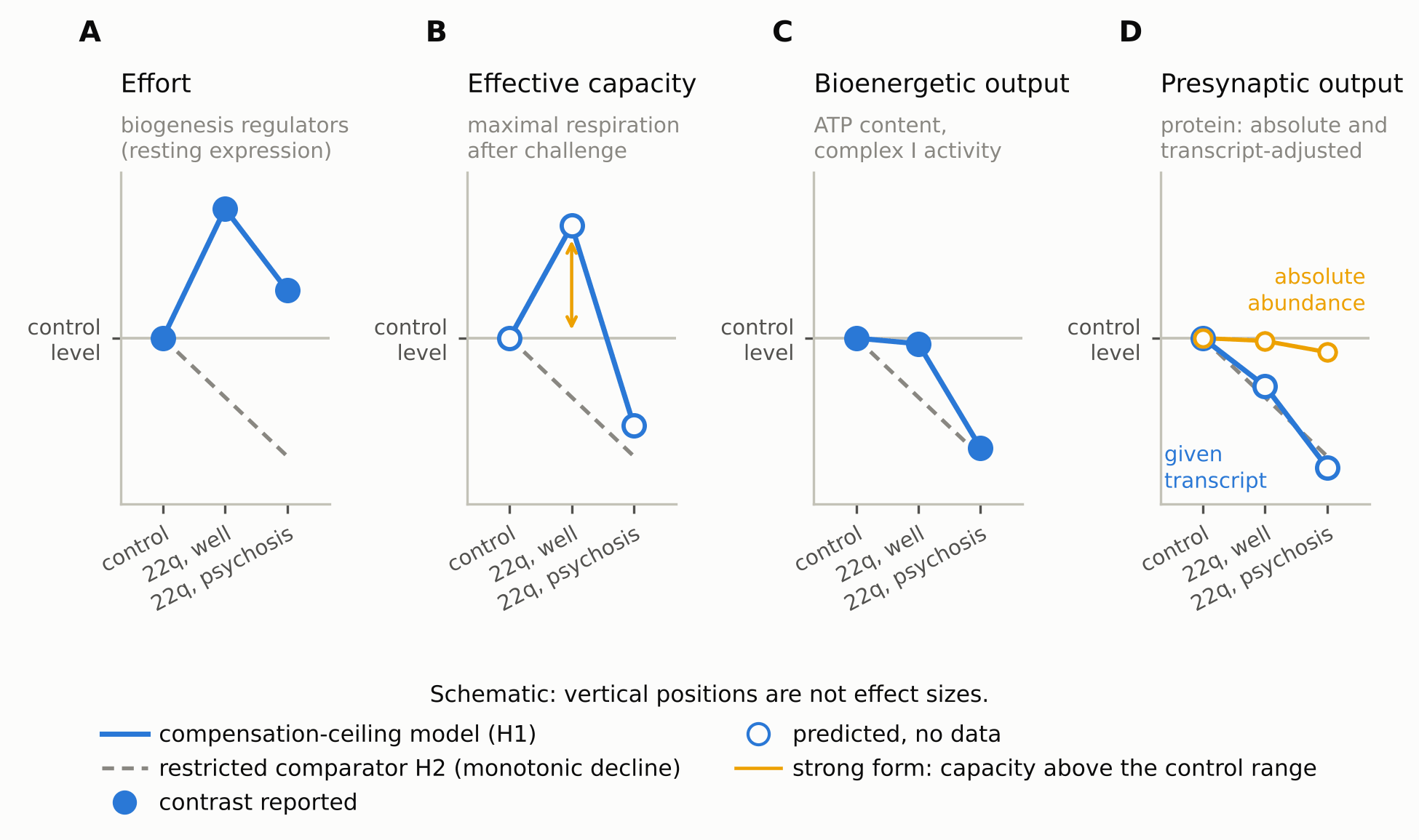
A model earns its structure only if some observation would favor it over rivals built from the same findings. Table 4 specifies five and gives what each predicts: H1, the account of Section 1.2; H2, static liability accumulation, with no distinct compensatory process, so biomarkers are monotonic across the three groups, stable within persons, and the same at rest and under challenge; H3, fixed vulnerability with stochastic trigger; H4, parallel subgroup routes through distinct primary lesions; and H5, developmental vulnerability with changing load. Figure 2 sets the H1 and H2 orderings side by side, quantity by quantity, and marks where data exist: the two coincide on presynaptic output, which is why no panel can stand for the set. H5 is the strongest comparator, and the only one worth the article's attention: it allows demand to rise and fall, modifiers to push risk in either direction and symptom components to run on different timescales, and so reproduces most of the observations this model was built from. What it does not contain is an active compensatory process that is recruited, costly and capable of being suppressed.
| Observation | H1 predicts | H2 predicts | H3 predicts | H4 predicts | H5 predicts |
|---|---|---|---|---|---|
| Three-group ordering on effort and challenge-evoked capacity | Non-monotonic: protected carriers exceed controls; the psychosis group resembles or falls below them | Monotonic: controls, protected carriers, psychosis group | No carrier-group difference at rest | Varies by subgroup | Non-monotonic is possible; no recruited process |
| Resting versus challenge-evoked measurement | Separation larger under challenge | Similar under both, scaled by burden | Minimal in either | Varies by subgroup | Larger under challenge, from fixed capacity limits |
| Within-person trajectory of compensation indices across transitions | Decline before emergence, preceding cognitive change; at remission the balance returns by recovering capacity or falling demand, identifiably | Stable traits; baseline predicts outcome without within-person change | Stable; change follows the trigger | No common trajectory | Decline before emergence; no effort term |
| Relation of genetic modifiers to the deletion | Act on the systems the deletion constrains; predict trajectory, not only endpoint | Modifiers add independently; endpoint prediction suffices | Index exposure risk | Partition by subgroup | Act on the same systems; signed effects allowed |
| Duplication carriers on capacity measures | Exceed controls, with effort at or below control | At or near controls; protection is reduced liability | At controls | Varies | Exceed controls on capacity |
| Dopamine–connectivity coupling across transition | Positive before onset, flattening or inverting across it | No specific prediction | No specific prediction | One subgroup only | No specific prediction |
| Durability of an intervention after it stops | Set by whether dosing fell inside the regulator's window; endpoint-specific within an animal; sign set by the pretreatment deviation | Set by the size of the effect on liability while it is applied, with no window and no sign reversal | Irrelevant without trigger removal | One subgroup only | Set by the developmental window |
| Suppressing the compensatory response in protected-carrier cells | Degrades output under load, more than in controls | No distinct response to suppress | No effect | Confined to one subgroup | No effect beyond the dosage deficit |
| Symptom dynamics | Positive symptoms track the fast balance; negative symptoms and function track the slow architecture and persist | Positive and negative symptoms remit together as liability falls | Follows trigger removal | Differs by subgroup | Fast and slow components, as in H1 |
The rivals are restricted forms, stated in Section 2.3, not general statements of the traditions they come from; H5 is the closest comparator and matches H1 everywhere except on the recruited, costly, suppressible compensatory process itself.
H1 is itself a threshold model, and what distinguishes it from H2 is what lies on either side of the threshold: in H1 the liability is a within-person state composed of two separately measurable and manipulable terms, one of them an active process that overshoots. Over-readings of that difference are disclaimed in Supplementary Section S6. What survives is narrow and is the whole of what Table 4 claims: of the five forms, only H1 predicts an actively recruited, costly, suppressible compensatory process strongest in carriers who remain well. H5 differs from H1 there and nowhere else, which is why Study 1's perturbation arm, and not any observational contrast, is what separates them.
3The Deleted Genes Are Regulators
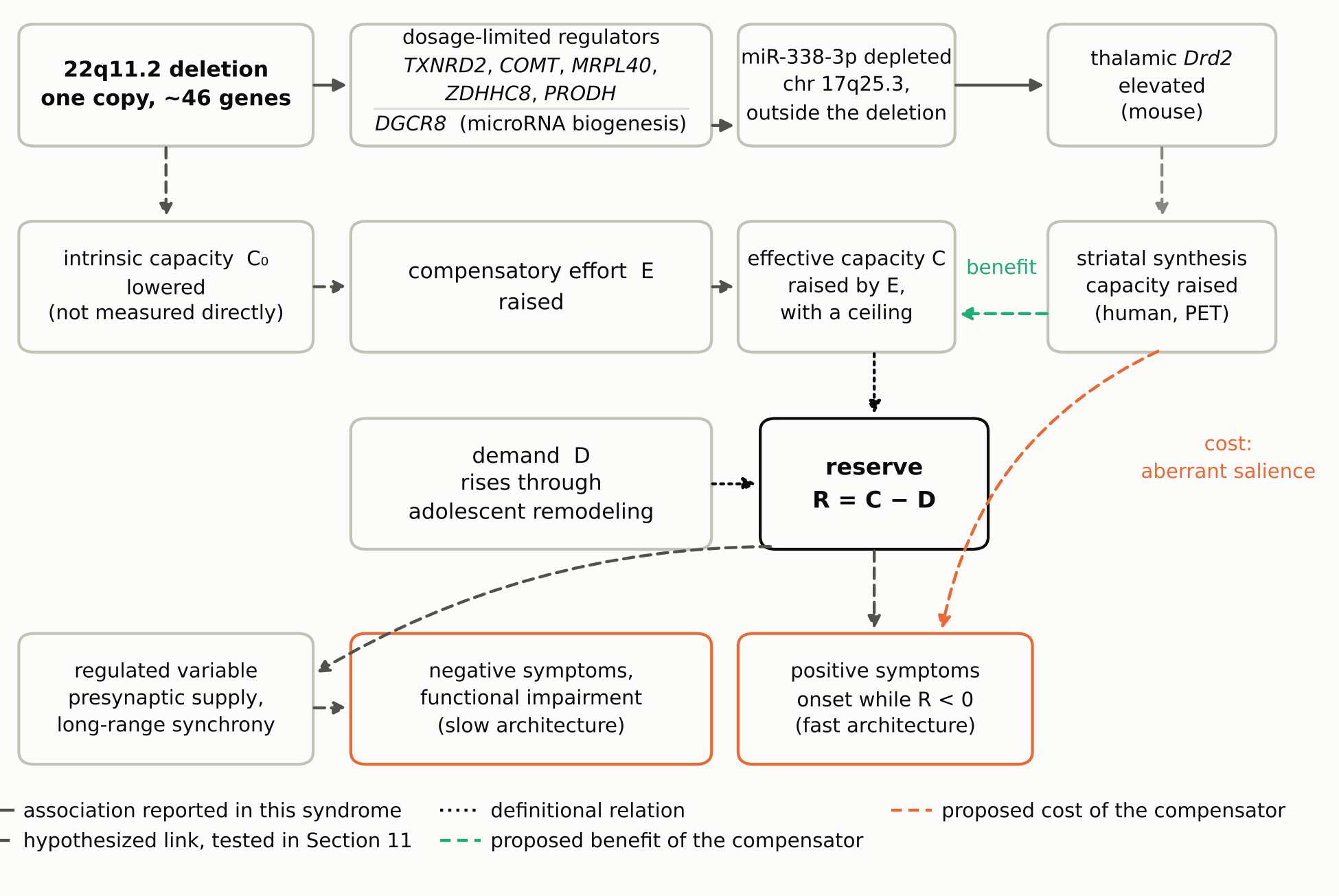
The organizing observation behind Proposition 1 is that the interval's neural relevance lies in genes that set the rate, gain or throughput of a process rather than in genes that specify a structure. This is a claim about the genes with demonstrated neural phenotypes, not a quantified enrichment across all 46, and TBX1, a patterning gene, does not fit it. Figure 3 maps the mechanism that this section and those following populate, marking each link as a definition, as a reported association, or as a hypothesis that Section 11 tests. The gene-by-gene case is in Supplementary Section S2; two genes carry the argument here.
TXNRD2 encodes the rate-limiting enzyme for clearance of mitochondrial hydrogen peroxide. Of six 22q11 mitochondrial genes screened by knockdown in wild-type cortical neurons, only Txnrd2 depletion reproduced the LgDel reduction in axon and dendrite growth, its re-expression restored growth and returned reactive oxygen species to wild-type levels, and the deficit was confined to layer 2/3 projection neurons, whose long-range association projections impose the highest bioenergetic demand (Fernandez et al., 2019). That is a dosage-limited regulator whose consequences surface where demand is greatest. COMT makes the compensation point directly: in Prodh-deficient mice frontal Comt is upregulated at message and protein from the third postnatal week, chronic NMDA-receptor blockade in wild-type mice phenocopies the regional pattern, identifying the upregulation as a response to altered transmission, and COMT inhibition unmasks deficits in the mutants only (Paterlini et al., 2005). One deleted gene is the compensator for another.
4The Signature Is Bidirectional Instability, Not Uniform Deficit
If the deletion removed one copy of a set of effectors, the expected phenotype would be partial deficits of roughly proportional size pointing in the same direction. That is not what is observed.
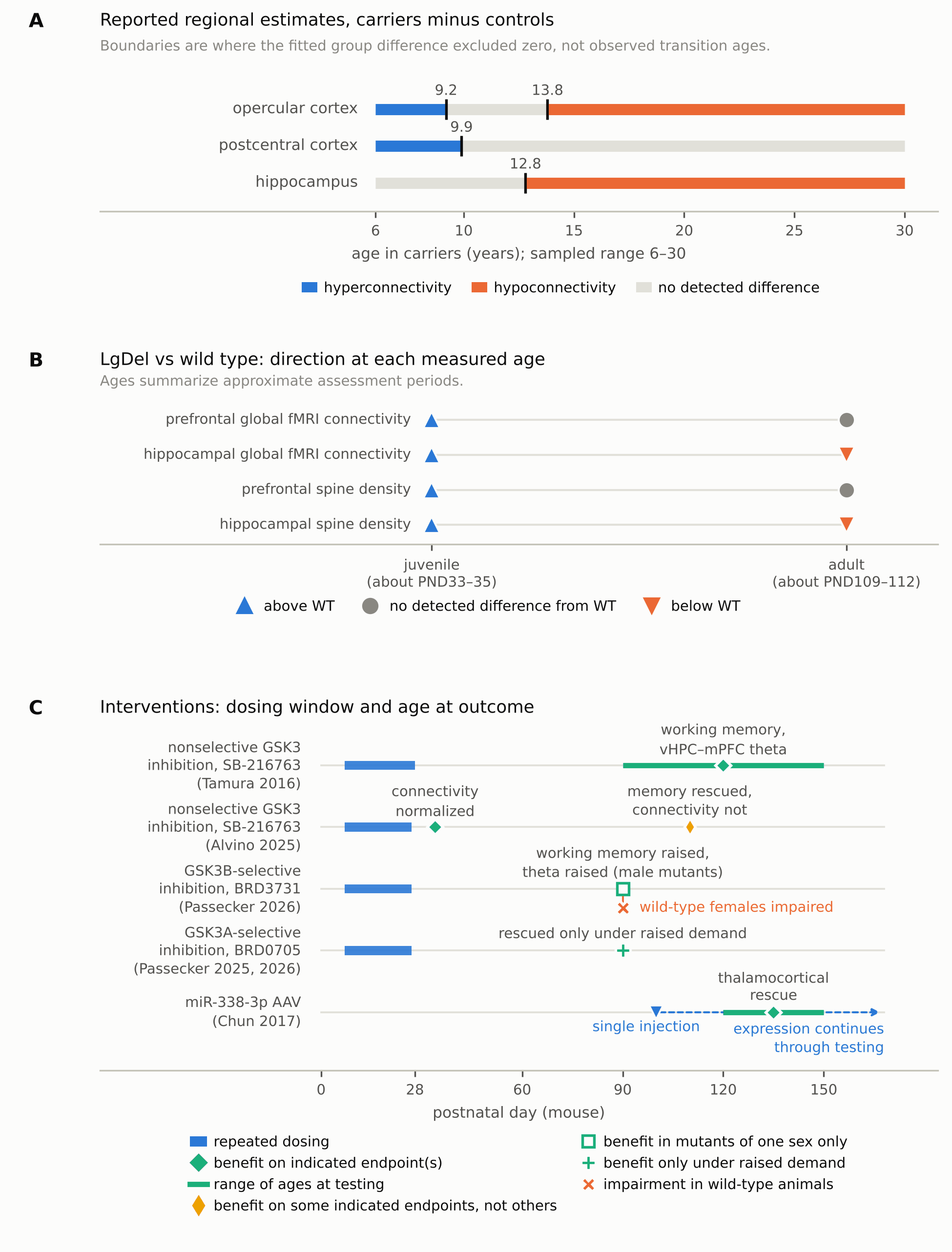
The clearest demonstration is longitudinal in mice and cross-sectional in carriers. LgDel mice scanned before and after puberty showed widely increased global functional connectivity as juveniles and decreased hippocampal connectivity as adults, in the same animals; in 139 carriers and 117 controls aged 6 to 30, prepubertal children showed foci of global hyperconnectivity while postpubertal carriers showed hippocampal and temporal hypoconnectivity (Alvino et al., 2025; Figure 4A, 4B). The anatomy behaves the same way: prefrontal spine density increased in juvenile mice and at wild-type level in adults, hippocampal density increased in juveniles and reduced in adults. The deletion does not produce too little connectivity. It produces the wrong amount, and which direction is wrong depends on when you look. The juvenile surplus is also what the demand term draws on, since a circuit arriving at puberty with more synapses has more to eliminate (Section 1.2).
Eight further findings fit the same shape and are catalogued in Supplementary Section S3, among them increased hippocampal long-term potentiation (LTP) (Earls et al., 2012), overgrowing thalamocortical axons (Shin et al., 2024), thicker cortex with substantially reduced surface area (Sun et al., 2020), and neurons that fire spontaneously about four times as often while showing smaller evoked calcium transients (Khan et al., 2020). The deletion's effect is better described as loss of set-point control than as loss of function.
Transcript–protein discordance is expected under Proposition 4, where transcriptional upregulation is the compensatory response and its failure to normalize protein stoichiometry is compensation falling short at the step the deletion constrains. That reading is not the only one available, and the alternative comes from the same paper: Nehme et al. (2022) propose that reduced TBX1 de-represses the activity-dependent transcription factor MEF2C, with JUN/FOS motifs most enriched among the upregulated genes, which would make the transcript elevation part of a developmental cascade and so part of the lesion rather than a response to it. That is a serious rival to the compensatory reading, and the two separate on prediction: a compensatory elevation should be larger in carriers who remain well and should worsen function when suppressed, whereas a MEF2C-driven elevation should track the deletion rather than psychosis status. Association with a favorable clinical status cannot distinguish beneficial compensation from differences in maturation, transcription, translation or degradation correlated with that status. Only perturbation can, which is why Study 1 carries a perturbation arm.
Two consequences follow. Signed averages across measures that move in opposite directions, and age-pooled contrasts on measures that reverse sign, both cancel, so the model requires signed, age-resolved, prespecified hypotheses for each quantity (Section 11). And bidirectionality alone is compatible with a 46-gene deletion simply producing many unrelated effects; what distinguishes Proposition 2 is that divergence should grow under load, which makes challenge-evoked measurement the discriminating design.
5The Regulated Variable and Its Circuit Expression
"Compensation" without a specified object is unfalsifiable. Proposition 3 names the object as synaptic maintenance in late-maturing association and hippocampal circuits, and makes a narrower bet about the bottleneck: presynaptic supply. The broad claim is what the evidence supports now; the narrow one is what Study 1 measures.
Five lines of evidence converge on synaptic maintenance, none presynaptic-specific on its own, and they are set out in Supplementary Section S3. Two carry the weight. Carrier neurons show broadly upregulated synaptic transcripts against reduced presynaptic protein, with 37 of the 182 downregulated SynGO-annotated synaptic proteins upregulated at the transcript level (Nehme et al., 2022). And Txnrd2 dosage limits synaptic vesicle density and presynaptic specializations in the layer 2/3 neurons whose projections impose the highest demand (Fernandez et al., 2019), with Mrpl40 hemizygosity disrupting presynaptic calcium handling under load (Devaraju et al., 2017). Adolescent remodeling is elimination and selective stabilization, and stabilization is the metabolically expensive half.
The circuit expression of a supply constraint is loss of the long-range coordination that depends on it. Hippocampal–prefrontal synchrony during working memory is drastically reduced in Df(16)A+/− mice, the line also designated Df(16)1/+ and called by the first name throughout this article, and coherence at the onset of training predicted how long acquisition took (Sigurdsson et al., 2010): a circuit measure that predicts the rate at which an animal can learn indexes capacity rather than damage. Naming the variable sets a boundary as well as a target. The model does not claim that bioenergetic failure is a universal bottleneck, or that metabolic demand explains regional vulnerability.
6Timing: A Crossing, Not a Gate
Proposition 5 holds that psychosis is timed by the point at which rising demand crosses falling capacity, rather than by a developmental gate that opens at a fixed age. Four lines of evidence support reading the timing as a crossing.
First, the deletion's consequences are latent and then expressed within the same genotype without further genetic change. Hippocampal LTP in Df(16)A+/− mice is indistinguishable from wild-type at 8–10 weeks and markedly elevated at 16–20 weeks (Earls et al., 2012), and thalamocortical Drd2 elevation with haloperidol sensitivity is present in Df(16)A+/− and Dgcr8+/− mice from three months and in neither at 1.5 or 2 months (Chun et al., 2017). What changes between those ages is the value of a regulatory variable in a maturing circuit, not the lesion. That the LTP result is an overshoot arriving after puberty, where the developmental claim of Section 4 is surplus before puberty and deficit after it, is not a conflict: that claim is about long-range connectivity, while what is dated here is the age at which a controlled variable first leaves its set point. Which direction it leaves in is set by the limiting controller; that it leaves at all, within one genotype between two ages, is the timing fact.
Second, and most important, the timing can be moved. miR-338-3p is enriched in thalamus, represses Drd2 through a conserved seed site, and declines with age; Dgcr8 hemizygosity exaggerates that decline. If the age dependence of the circuit phenotype is produced by that trajectory, removing the regulator should remove the age dependence, and it does: Mir338+/− heterozygotes show the thalamocortical deficit, its haloperidol sensitivity and the prepulse inhibition abnormality at every age tested, and a miR-338-3p sponge confers haloperidol sensitivity on wild-type projections at 2 months (Chun et al., 2017; Figure 1C). Conversely, replenishment by adeno-associated virus (AAV) in the medial geniculate, given well after the phenotype has appeared, rescues it; of five depleted Drd2-targeting microRNAs, only miR-338-3p did. Two qualifications hold. Human MIR338 lies on chromosome 17q25.3, outside the deleted interval, so it is a downstream regulator rather than a deleted gene. And the depletion is demonstrated in mouse models, not in human carriers, where the corresponding observation is in schizophrenia postmortem thalamus; that carriers show it is a prediction of this model rather than a fact. These experiments measured neither demand nor capacity. What they show is that a regulator's trajectory sets the clock.
Third, the adolescent inflection is selective: in LgDel/+ mice, social deficits, the failed adolescent increase in prelimbic thickness and microglial C4 elevation all appear at adolescence, while sensorimotor gating deficits are present from postnatal day 19 (Castellani et al., 2025). Some consequences of the deletion are constitutive and some adolescence-dependent, and it is the latter that track the human risk period. Fourth, what changes in carriers before psychosis indexes the capacity to meet cognitive demand rather than structural loss: verbal IQ declines more steeply in those who go on to psychotic illness (Vorstman et al., 2015), polygenic burden predicts that decline (Davies et al., 2020), and youth with prominent psychosis-spectrum features declined specifically in working memory (Gur et al., 2023). Carriers with psychosis differ from carriers without in cortical thickness (Bagautdinova et al., 2021) but not in surface area (Sun et al., 2020), the measure that most strongly separates carriers from controls: the deletion sets surface area, and remodeling sets who converts.
7Symptom Dynamics: The State Is Reversible, and Its Components Dissociate
If psychosis in this syndrome were accumulated damage, symptoms should be largely monotonic once established. They are not. Among 72 carriers with a longitudinal clinical classification, followed for a mean of 2.8 years, psychosis-spectrum symptoms were consistently absent in 22, emergent in 9, remitted in 16 and persistent in 25 (Tang et al., 2017). Sixteen of 41 symptomatic carriers crossed back out of the symptomatic state within three years, which is the observation the model needs: a state that resolves is a balance, not a scar.
What that cohort cannot establish is an asymmetry between entry and exit, and this article does not claim one. The comparison group, non-deleted youth from the Philadelphia Neurodevelopmental Cohort, was followed for 2.0 years against the carriers' 2.8, and cumulative proportions over unequal windows are not comparable. Converted to annual hazards, emergence runs at 0.115 per year in carriers against 0.084, a ratio of 1.4 rather than the doubling the raw proportions suggest; remission runs at 0.162 against 0.286, a ratio of 0.57. A narrowed margin predicts that pattern once both of its terms are allowed to move, but so does an accumulating lesion, so the comparison does not discriminate and is not used to. With 41 symptomatic carriers the remission estimate is imprecise in any case. What the model requires from this cohort is that exit occurs at all, and it does.
The discriminating observation is the dissociation within the symptoms. Negative symptoms and functional impairment continued to mark carriers whose positive symptoms had remitted, and were higher at baseline in the group whose positive symptoms later emerged (P = 0.03), although that factor did not significantly predict emergence or persistence once entered in a regression (P = 0.82) (Tang et al., 2017). The persistence half is the load-bearing one, and it is unambiguous. Deriving it requires saying which quantity is fast and which is slow, because a single C cannot be both. Effort and the effective capacity it buys are fast and recoverable, being expression and activity levels in a regulatory system. Demand is slow and, through adolescence, monotonic. Slow and only partly reversible is the architecture of the regulated variable: synapses formed or lost, long-range synchrony, and the structural consequences of having run with negative reserve. Positive symptoms track the sign of reserve, which is fast because one of its terms is; negative symptoms and functional impairment track the architecture, which is why restoring the balance returns the first and not the second. Of the rivals in Table 4, only H1 predicts that ordering rather than stipulating it.
The same accounting constrains what remission shows. Because R = C − D, the balance can be restored either by capacity recovering or by demand falling, and the model asserts that both routes exist rather than requiring the first. Figure 1B draws them separately, because they are empirically distinguishable. That is testable, and no rival makes the prediction: the routes should dominate at different ages. Remission late in the risk window should occur with demand falling and capacity flat; remission earlier, while demand is still rising, should require capacity to recover.
Three limits are developed in Supplementary Section S6: remission of subthreshold symptoms is not remission of a psychotic disorder; symptom remission does not show that structural abnormalities have resolved; and affective comorbidity moves with symptom course, so Study 3 measures affective state rather than assuming it away.
8Dopamine as a Compensator with a Cost
Proposition 6 departs from the framing in which striatal hyperdopaminergia is the final common pathway for psychosis. Three lines of evidence support the departure, and they concern three different measures the model connects by hypothesis.
The mechanistic evidence places thalamic receptor expression downstream of regulator loss: thalamic Drd2 elevation is attributable to Dgcr8 hemizygosity, and its proximate cause is depletion of miR-338-3p, which is necessary and sufficient for the phenotype (Chun et al., 2014, 2017). The human imaging evidence establishes the dosage relationship: in 21 deletion carriers, 12 duplication carriers and 26 controls, all antipsychotic-naive, copy number had an inverse linear effect on whole-striatal Kᵢᶜᵉʳ (B = −1.2 × 10⁻³ min⁻¹ per copy, p < 0.001), with deletion carriers exceeding controls by d = 1.44 (Rogdaki et al., 2023). Synthesis capacity was also associated with psychosis-risk symptom severity (B = 730.5, SE = 310.2, p < 0.05), estimated across the combined deletion and duplication sample with copy-number group in the model, so the symptom association is adjusted for copy number rather than demonstrated within deletion carriers alone.
The multimodal evidence concerns network configuration and resists the reading that hyperdopaminergia is simply pathogenic. Across antipsychotic-naive carriers and controls, with group in the model, higher striatal synthesis capacity was associated with functional connectivity profiles more like those of controls (p = 0.011), while connectivity showed no relationship with subclinical symptoms (Mancini et al., 2026). The within-carrier version of that association is weaker and sensitivity-dependent, and a profile more similar to controls is a resemblance rather than a demonstrated benefit. Taken together the three lines describe a variable raised by loss of a regulator, varying inversely with regulatory dosage, accompanying more normative network organization and accompanying more severe psychosis-risk symptoms. Under Proposition 6 that is what a compensator with a perceptual cost looks like: elevated presynaptic dopamine raises the gain with which salience is assigned, stabilizing network states under degraded input and raising the probability that neutral stimuli acquire significance.
The proposition therefore makes two claims, tested separately because neither implies the other. The benefit claim: raising synthesis capacity improves a circuit property the deletion degrades, measured against performance or stability rather than resemblance. The cost claim: the same elevation increases aberrant salience. Dopamine can do both at once across the whole observed range, so a positive dopamine–connectivity association does not show the cost is absent. The cost claim predicts specifically that the symptom association survives adjustment for connectivity; if positive symptoms track dopamine only through network disruption, the proposition loses half its content.
Placing dopamine beside the reserve equation forces a choice, because the two could otherwise generate symptoms independently. Reserve governs the transition; dopaminergic state governs severity within a state. Crossing into, and out of, the psychosis-spectrum state requires a change in the sign of reserve. Dopaminergic gain modulates how intense symptoms are and how often subthreshold experiences occur within a state, and can move with no change in capacity or demand. This is what makes Study 3's falsifier coherent: a transition with no measurable movement in either term would refute the balance account, whereas fluctuation in severity without such movement would not. It is also a claim in its own right, and it fails if transitions track dopaminergic measures with reserve held constant.
A third and weaker prediction is retained as an additional test rather than a decisive one, and is set out in Supplementary Section S4: the sign of the dopamine–connectivity relationship should invert across transition, which no rival in Table 4 predicts but which medication, illness stage, sampling and range restriction can also produce.
9Barrier and Immune Load
The model assigns the barrier and immune limb a specific and now load-bearing role: CLDN5 hemizygosity destabilizes barrier tone, admitting a peripheral immune load that varies between carriers and adds to demand. It supplies the maintenance component of the demand excess (Section 1.2), and it is the component that varies within the carrier group, which makes it a candidate source of penetrance variation rather than a uniform deletion effect. The animal evidence is causal and places barrier tone upstream: neonatal intranasal oxytocin in LgDel/+ mice raised claudin-5, sealed the barrier, prevented microglial C4 and C1q elevation and prevented the adolescent social deficit (Castellani et al., 2025). The human limb is weak on both sides, and Supplementary Section S5 sets out why. Because the demand prediction rests partly on this limb, Study 1 measures immune load alongside the bioenergetic endpoints.
10The Reciprocal Duplication as a Dose Test
The locus supplies something almost no other psychiatric risk variant does: a reciprocal duplication with an opposite phenotype. In 21,138 schizophrenia cases and 25,867 controls, duplications occurred in 0.014% of cases and 0.085% of controls, odds ratio 0.17 (95% CI 0.05–0.56); the same duplication raises risk of intellectual disability, developmental delay and congenital malformation (OR 3.75, 2.29–6.15) and of autism spectrum disorder (OR 3.29, 1.63–6.61) (Rees et al., 2014; Supplementary Figure S1). That dissociation is the most constraining fact available to any theory of the locus: an account on which the deletion impairs brain development along a single dimension has to explain how adding a copy moves one outcome down while moving two others up. A developmental account accommodates it by positing distinct dosage-sensitive processes with opposite requirements, so what the dissociation refutes is not developmental accounts as a class but any version in which one quantity of developmental burden orders all three outcomes.
The compensation-ceiling model is constrained by it and accommodates it. Under Proposition 1, increased dosage of rate- and gain-setting genes raises intrinsic capacity, which is protective during the adolescent window when correction is rate-limiting and harmful during early construction, when developmental programs require accurately timed derepression rather than maximal throughput: excess microprocessor capacity silences targets that should be expressed. That is falsifiable in a specific way. It requires duplication carriers to exceed controls on capacity with effort at or below control level, which is the signature of raised intrinsic capacity rather than of recruited compensation, and not merely to sit opposite deletion carriers on a regulated output, which is all the existing dopamine data show (Rogdaki et al., 2023). Study 2 tests that stronger version and supplies the program's sharpest specificity comparison: a capacity measure relevant to psychosis protection should not track intellectual disability or autism severity in the same direction.
11Falsification: Four Decisive Programs
A model that accommodates any observation explains nothing. The four programs below state what would refute this one, each as claim at risk, prediction, design and falsifying result.
One rule for every contrast, and no composites. Every primary contrast fixes a minimum meaningful effect, δ, and reports a 90% interval; the four outcomes it can return are defined in Supplementary Section S7.1, as is what counts as a carrier who remains well. Because the model predicts opposite directions for different quantities on different scales, a signed average cancels, so each quantity keeps its own endpoint and direction, and primary hypotheses are signed and challenge-evoked wherever the biology permits. Where the model predicts a pattern, global support requires every component contrast to meet its criterion, an intersection–union rule conservative in the direction of not claiming support. Falsification is not the mirror image of that rule. Failing to establish a conjunction is not evidence that any component is false. A component counts as evidence against only when its own upper bound lies below δ, and the model as a whole is refuted when at least one such bound lies below δ under simultaneous limits across the required contrasts. Simultaneity, rather than a majority vote, is what stops several components from manufacturing repeated chances to reject (Supplementary Section S7.3).
11.1Study 1: The three-group compensation assay
Claim at risk. Compensatory effort is raised in carriers who remain well, it buys effective capacity, and the response is beneficial rather than merely correlated with being well (Proposition 4). The core form is the model's defining commitment; the strong form adds capacity above the control range and is tested separately.
Prediction. Four quantities, four endpoints, four directions, with one primary measure for each so that the decision rule applies to a named contrast rather than a family. Demand, maintenance component: basal respiration under controlled workload is higher in both carrier groups than in controls. Demand, remodeling component: synaptic density before the elimination window is higher in carriers, measured where a surplus can exist, which means cortical organoids at a matched differentiation stage with mouse spine density as the cross-species anchor. A monolayer of reprogrammed neurons has no architecture to eliminate and cannot report this quantity whatever its respiration shows. Together these are the prediction the rest of the arithmetic depends on. Effort: resting PGC-1α is higher in carriers who remain well than in controls and than in carriers with psychosis, with PGC-1β, PPARα and PRKN secondary. Capacity: maximal respiration after substrate challenge is higher than in the psychosis group, and in the strong form higher than in controls. Output: presynaptic protein is at control level in absolute terms in carriers who remain well and below control conditional on transcript.
Prediction, perturbation arm. This arm, not the three-group contrast, is what Proposition 4 stands on. No observational contrast can show that a response is beneficial, since any variable correlated with clinical status produces one, and none can show it was recruited, since reprogramming erases acquired state and leaves a constitutive difference looking exactly like a spent one. The decisive test is perturbation inside protected-carrier cells: suppressing the controllers should degrade output under load, and more than in control cells; restoring them should recover it. The four controllers are fixed in advance as the definition of effort, so elevations elsewhere cannot be reclassified afterward as unsuccessful effort. The source demands that commitment: ERRα was elevated in both carrier groups relative to controls on the figure legend's reading and unchanged between carrier groups on the Results text's, and a definition fixed afterward could accommodate either (Li et al., 2021).
Design. Excitatory neurons, cortical organoids and a lineage-authenticated brain endothelial system from the three groups, at least two clones per donor, groups matched on age distribution. Derivation method is prespecified because it decides what the assay can see: directly converted neurons retain donor age-associated transcriptomic signatures that induced pluripotency erases (Mertens et al., 2015). The dosage and effort hypotheses are therefore tested in iPSC-derived neurons, the decline hypothesis in directly converted neurons from the same donors, and the remodeling component of demand in organoids. The primary intersection–union test runs in directly converted neurons, with the other systems as prespecified replications. Sample size is simulated for the named primary endpoints under stipulated planning effects, and reaches 93% at 40 donors per group for a planning effect of d = 0.8 (Supplementary Section S7.2 and S7.3). Fifty donors per group across three groups and two derivation routes is consortium-scale against the fourteen lines of the study it builds on, and is staged: 20 per group first, as a pilot estimating the variance components the full target depends on.
Falsifying result. Each contrast is judged by the rule above, so an interval spanning zero and δ leaves its claim undecided rather than refuted. The demand prediction fails if basal respiration in carriers is not above control level with an upper bound below δ, and its failure is the most consequential of all: without a demand excess, raised capacity gives carriers the larger margin and the clinical premise of Section 1.2 collapses. The core form fails if the effort contrasts reach evidence against, not merely if they fail to reach support. The second half of Proposition 4 fails if effort is raised while capacity does not exceed the psychosis group; the strong form fails if capacity does not exceed controls while both carrier-group contrasts hold. Only the perturbation result separates this model from H5: if suppressing the controllers in protected-carrier cells does not degrade output under load more than in control cells, there is no recruited compensatory process to speak of.
11.2Study 2: The reciprocal copy-number dose test
Claim at risk. Capacity is set by dosage, so the duplication raises it above the control range with no effort recruited, and the capacity that protects against schizophrenia is schizophrenia-specific (Propositions 1 and 6).
Prediction and design. On the Study 1 capacity endpoints, duplication carriers exceed controls with effort at or below control level. The joint position is the prediction, and it separates endowment from compensation: a well deletion carrier is also predicted above controls on capacity, but only with effort above them. Intrinsic capacity is the quantity predicted to be monotonic in copy number; effective capacity is not, because effort intervenes. The design is a three-arm comparison on the Study 1 endpoints, with autism and intellectual-disability phenotypes measured dimensionally (Supplementary Section S7.5): capacity should be associated with better psychosis outcomes and with equal or worse autism and intellectual-disability outcomes.
Falsifying result. The dosage–capacity link of Proposition 1 reaches evidence against if the duplication-versus-control capacity contrast has an upper bound below δ; a contrast that merely fails to exclude zero leaves the link undecided. If duplication carriers exceed controls on capacity and on effort, they are compensating rather than endowed, and the quantity measured is not intrinsic capacity. The schizophrenia-specific reading fails if capacity is associated with lower adverse scores across psychosis, autism and intellectual disability alike, which would indicate a general developmental-burden measure.
11.3Study 3: Is capacity consumed before emergence, and what restores the balance?
Claim at risk. Capacity declines within persons before symptoms emerge, and the decline is a cost of prior compensation rather than a property of age (Propositions 4 and 5). The first half, with Study 1, is the model's other indispensable claim. The second half is separable: a decline that precedes symptoms establishes temporal precedence but not consumption, since age-related change in regulatory expression, maturation or an illness process already under way would produce the same trajectory. The model therefore commits to something sharper, that earlier effort predicts later capacity loss once age and demand are in the model. If that fails, the word consumption is withdrawn while temporal precedence survives.
Prediction. (a) In carriers whose symptoms emerge, a validated compensation index declines within person beforehand, and before cognitive change. This is the indispensable one, and onset is where the model is properly exposed: stable capacity with rising demand would also produce a transition, so the model commits to capacity falling and not merely to the balance crossing. (b) Cumulative effort over the preceding interval predicts the magnitude of that loss, with age and demand in the model, which is the test that distinguishes consumption from age. (c) At remission the balance is restored by one of two identifiable routes, and which one is age-dependent: late in the window, developmental demand falls with capacity flat; earlier, either capacity recovers or an additional load falls (Section 9). (d) Whichever route operates, the reserve index recovers further than measures of the regulated variable. (e) The cognitive signature preceding emergence is disproportionately load-dependent.
Design. A multisite prospective cohort entered uniformly between ages 12 and 18 and followed to 25, with six-monthly symptom assessment, an annual biological battery and event-triggered sampling within eight weeks of any status change (Supplementary Section S7.7). The primary compensation index is peripheral bioenergetic capacity under challenge, with biogenesis transcripts as the effort term and basal consumption as the demand term, so that capacity and demand are measured separately rather than inferred from a single margin. It becomes primary only on meeting prespecified thresholds for reliability, for responsiveness to a challenge of known direction, and for correspondence between its change and change in a central measure.
Falsifying result. Compensation is a liability marker rather than a dynamic variable if carriers whose symptoms emerge show no within-person decline beforehand among those with adequately timed samples, and the indispensable dynamic claim then fails. It is a consequence rather than an antecedent if the index declines only after cognitive change or after onset. The consumption claim fails, while temporal precedence survives, if cumulative effort does not predict subsequent capacity loss with age and demand in the model. The balance account fails if a transition occurs with no measurable movement in either term. Fluctuation in severity without such movement does not count, since the model assigns severity to dopaminergic state (Section 8).
11.4Study 4: What makes an intervention's benefit outlast it
Claim at risk. Durable benefit is produced by intervening inside the developmental window in which a regulator sets a circuit's trajectory, not by whether the target lies inside the deleted interval; durability is endpoint-specific within the same animal; and the sign of an intervention's effect is set by the direction in which the regulator deviates before treatment. The first two claims are shared with H5. Only the sign claim is distinctive, because only this model ties the direction of a treatment effect to a measurable pretreatment deviation, and it is the model's most consequential practical prediction.
What the literature establishes. Four studies gave a GSK3 inhibitor from postnatal day 7 and tested animals months later; Figure 4C places them on a common age axis and Supplementary Section S7.9 sets them out. Two nonselective courses produced benefit at three to five months and at about postnatal day 110 (Alvino et al., 2025; Tamura et al., 2016). The paralog-selective pair is more informative, because together they turn this model's own methodological prescription into a result. GSK3B-selective BRD3731 improved working memory in adult male mutants and raised ventral hippocampal (vHPC) to medial prefrontal (mPFC) theta coherence in them (p = 0.048), raised rather than restored, since coherence was not significantly reduced in mutants of either sex at baseline (Passecker et al., 2026). GSK3A-selective BRD0705 was null in that experiment — but the same group, in the same model and window, found it restored adult spatial working memory when the task was run under increased working-memory demand (Passecker et al., 2025). A compound that is null at baseline and effective under load is not a failed intervention; it is Proposition 2 arriving as pharmacology, and it is why every endpoint here is challenge-evoked wherever the biology permits. Durability is endpoint-specific within one experiment: in the animals whose adult memory was rescued, juvenile normalization of connectivity did not survive, adult hippocampal hypoconnectivity was unaffected, and sociability was not rescued at either age (Alvino et al., 2025).
Mechanism of persistence. The model owes one, because R = C − D has no memory: if raising capacity is followed by the regulator returning toward its untreated state, nothing in the equation explains why benefit remains. The specified mechanism is developmental. Inside the window, the regulator sets the trajectory along which a circuit matures, and a circuit that has matured along a corrected trajectory is self-maintaining afterward; what persists is the structure, not the regulatory state that produced it.
Sex is where the sign claim meets its nearest existing test, and the fit has to be described exactly. BRD3731 improved working memory in male mutants, had no effect in female mutants, and impaired it in wild-type females, while Gsk3b expression was higher in male mutants than male wild types and lower in female mutants than female wild types (Passecker et al., 2026). The animals with reduced expression are therefore not the animals that were harmed. Read as a deviation rule rather than a level rule the pattern is informative: the inhibitor corrected an upward deviation and helped, and moved wild-type females away from their own set point and harmed them. But the comparison that would complete it, drug against vehicle in wild-type males, is not reported, nothing was tested within animals, and expression is not kinase activity, which was not measured (Supplementary Section S7.8).
Prediction. Four hypotheses, tested separately, with sex crossed throughout. (a) Window: benefit outlasting cessation follows dosing inside the window and not outside it, whatever the target. (b) Endpoint specificity: persistence differs across endpoints within the same animals, and is greater for endpoints still maturing during dosing. (c) Sign: the direction of effect is predicted by the pretreatment direction of the regulator's deviation, measured per animal. (d) Mediation: benefit is mediated by change in the regulated variable, with target class adding little once that change is in the model.
Design. A factorial experiment in LgDel/+ or Df(h22q11)/+ mice crossing target class with dosing window, the windows being pre-adolescent, peri-adolescent at the inflection, and post-adolescent, with sex crossed and each arm titrated to a prespecified fractional restoration of its proximal variable. Endpoints are chosen in pairs whose maturation windows differ demonstrably, since uniform persistence across endpoints that mature together would say nothing about specificity. Cessation must be real and engagement measured at outcome: none of the four studies above assayed target engagement months after dosing. The sign arm carries a measurement problem the design must solve rather than assume away, since an animal cannot be sampled for a regional brain transcript and then followed (Supplementary Section S7.8).
Falsifying result. The window claim fails if persistence after verified disengagement tracks target identity rather than dosing window, and in particular if late restoration of a deleted regulator outlasts disengagement while early action on a node outside the interval does not. Endpoint specificity fails if persistence is uniform across endpoints within animals. The sign claim fails if pretreatment regulator direction does not predict the direction of response, which would leave Proposition 2 without treatment-relevant content. Mediation fails if an intervention restores its variable with verified engagement and leaves the phenotype unchanged.
11.5What would falsify the model as a whole
Two claims are indispensable. The inversion, in its core form: on effort, carriers who pass through the risk window without psychosis lie above controls and above carriers with psychosis, and suppressing that response degrades function under load (Study 1). And consumption: capacity declines within persons before symptoms emerge (Study 3). If either produces evidence against under the decision rule, the model should be abandoned rather than repaired.
What replaces it should be stated with the same care as the model itself. Evidence against those two claims rejects the specified form of H1 and leaves the specified form of H2 standing; it does not establish H2 against every alternative, since a compensatory process on a variable this program did not measure would remain compatible. That is why the measured quantities are prespecified and named. The honest statement of a negative result is that the compensation architecture, as specified and measured here, is not what distinguishes carriers who become psychotic.
Four claims are distinctive, and their failure leaves an ordered developmental account standing while collapsing this model into a neighbor: the strong form of the inversion (Study 1); the window and sign claims about intervention durability (Study 4); the dose extension (Study 2); and the biological counterpart of the symptom dissociation (Study 3), whose clinical form already has support (Tang et al., 2017).
Three claims are accessory: which quantity dominates; the interchangeability of two regulator-restoring routes; and the identity of the executor of synaptic elimination. The barrier and immune limb is not among them, and nor is it indispensable. It supplies the maintenance component of the demand excess (Section 1.2), so its failure costs the model one of two independent grounds for that excess and leaves the remodeling component standing; it is load-bearing for a claim that does not rest on it alone.
What would not count. Six results that would not count against the model are listed in Supplementary Section S7.10, among them any null on resting measures without challenge-evoked ones, any null pooled across puberty on a measure known to reverse sign, and an upper bound below δ reported as evidence that compensation does not exist when what it rejects is an effect of at least δ.
12Scope
Five boundaries govern what the model claims, and Supplementary Section S6 develops them. The syndrome licenses a claim about process, not sequence: the deletion engages the same biology as distributed schizophrenia liability (Cheng et al., 2026; Cleynen et al., 2021; Davies et al., 2020; Lin et al., 2023; Nehme et al., 2022), which does not make the two routes to illness the same. The compensation signature is measurable outside the deletion (Das et al., 2022), but as a two-group finding rather than a replication of the three-group inversion. The model specifies one component of synaptic accounts of idiopathic schizophrenia (Howes & Onwordi, 2023; Moore, 2026). The programs test transitions in psychosis-spectrum status, not whether the state entered is specifically schizophrenia (Schneider et al., 2014). And a cellular model of a consumed state is constrained by its derivation.
13Synthesis
The 22q11.2 deletion removes one copy of a set of genes that, where their neural phenotypes are known, are dosage-limiting for a rate, a gain or a throughput. The model holds that losing one copy narrows the range over which a controlled variable can be corrected; that the resulting instability of set points is what the syndrome shows, most clearly in a connectivity phenotype in surplus before puberty and in deficit after it in both species; that every carrier compensates, in six distinct and separately predicted quantities; and that psychosis occurs where the demand of adolescent remodeling crosses a capacity falling because the regulators the deletion constrains decline with age. The clock is a regulatory variable, not a program. The state is a balance, not a scar.
Separating the quantities is what makes the model refutable, and also what shows where it is most exposed. That a carrier who maintains output from lowered dosage is expending effort follows from the structure. That the effort carries capacity above the control range does not; it is a further bet, and the program that tests it is built so that losing the bet costs the model its sharpest claim without taking the architecture down. Capacity declining before onset is indispensable, because a compensation index that never moves within a person is a liability marker with a new name.
The model's first demonstration is twenty years old and two genes wide: frontal Comt upregulated as a homeostatic response to Prodh loss, with carriers hemizygous for both, so that the locus impairs synaptic function and the compensatory response to it together (Paterlini et al., 2005). The most recent is narrower still and points the same way. A GSK3B-selective inhibitor given from postnatal day 7 to 27 improves working memory and raises prefrontal–hippocampal synchrony in adult male deletion mice, does nothing in female mutants and impairs wild-type females, in a line where Gsk3b expression deviates from wild type in opposite directions by sex; its GSK3A-selective counterpart is null at baseline and effective under increased load (Passecker et al., 2025, 2026). A regulator deviating in opposite directions, an intervention that helps where it opposes a deviation and harms where it creates one, and a benefit visible only when the circuit is pushed: three of this model's commitments arriving as pharmacology, though not yet as a test of them, since no animal's own pretreatment level predicted its own response. What it implies is a treatment principle rather than a treatment — measure the direction of the deviation before pushing on it, and measure the effect under load.
The value of this syndrome has never been that it is a window onto mechanism; there is no shortage of mechanism. Its value is that it holds the lesion fixed and lets the outcome vary, which makes the question of why outcome varies answerable, and answerable means refutable.
Transparency and Openness
Generative artificial intelligence. The author used Claude Opus 4.8, Claude Fable 5.1, GPT-5.5 Pro Extended, and Grok 4.3 to prepare and revise drafts and for proofreading. The author reviewed and edited all content and takes full responsibility for it. No AI tool was used to generate or analyze empirical data for this theoretical article.
Data and materials. This article reports no new empirical data. Every quantitative value cited is taken from the published source indicated, and the simulation inputs and outputs for the cohort projections in Supplementary Section S7.7 are stated there in full so that they can be reproduced.
Declaration of competing interest. The author declares no competing interests.
Funding. This work received no specific grant from any funding agency.
References
Alvino, F. G., Gini, S., Minetti, A., Pagani, M., Sastre-Yagüe, D., Barsotti, N., De Guzman, E., Schleifer, C., Stuefer, A., Kushan, L., Montani, C., Galbusera, A., Papaleo, F., Kates, W. R., Murphy, D., Lombardo, M. V., Pasqualetti, M., Bearden, C. E., & Gozzi, A. (2025). Synaptic-dependent developmental dysconnectivity in 22q11.2 deletion syndrome. Science Advances, 11(11), eadq2807. https://doi.org/10.1126/sciadv.adq2807
Bagautdinova, J., Zöller, D., Schaer, M., Padula, M. C., Mancini, V., Schneider, M., & Eliez, S. (2021). Altered cortical thickness development in 22q11.2 deletion syndrome and association with psychotic symptoms. Molecular Psychiatry, 26(12), 7671–7678. https://doi.org/10.1038/s41380-021-01209-8
Bassett, A. S., Lowther, C., Merico, D., Costain, G., Chow, E. W. C., van Amelsvoort, T., McDonald-McGinn, D., Gur, R. E., Swillen, A., Van den Bree, M., Murphy, K., Gothelf, D., Bearden, C. E., Eliez, S., Kates, W., Philip, N., Sashi, V., Campbell, L., Vorstman, J., … Marshall, C. R., & International 22q11.2DS Brain and Behavior Consortium. (2017). Rare genome-wide copy number variation and expression of schizophrenia in 22q11.2 deletion syndrome. American Journal of Psychiatry, 174(11), 1054–1063. https://doi.org/10.1176/appi.ajp.2017.16121417
Castellani, G., Ciampoli, M., Benedetti, A., Ferretti, V., Trigilio, G., Barcik, W., Busnelli, M., Contarini, G., Paolini, C., Devroye, C., Rodriguez Aburto, M., Cucinelli, A., Antonelli, F., Maltese, F., Braccia, C., Pacinelli, G., Managò, F., Rodríguez-Gimeno, A., Mazzarella, M. A., … Papaleo, F. (2025). Oxytocin seals the blood–brain barrier, improving 22q11.2 deletion syndrome trajectories. Brain, 148(9), 3184–3198. https://doi.org/10.1093/brain/awaf112
Cheng, M., Yin, Y., Engchuan, W., Heung, T., International 22q11.2 Brain Behavior Consortium, Morrow, B. E., Bassett, A. S., & Yuen, R. K. C. (2026). Genome-wide tandem repeat expansions modify schizophrenia risk in the presence of a 22q11.2 deletion. Molecular Psychiatry, 31, 4934–4946. https://doi.org/10.1038/s41380-026-03574-8
Chun, S., Du, F., Westmoreland, J. J., Han, S. B., Wang, Y.-D., Eddins, D., Bayazitov, I. T., Devaraju, P., Yu, J., Mellado Lagarde, M. M., Anderson, K., & Zakharenko, S. S. (2017). Thalamic miR-338-3p mediates auditory thalamocortical disruption and its late onset in models of 22q11.2 microdeletion. Nature Medicine, 23(1), 39–48. https://doi.org/10.1038/nm.4240
Chun, S., Westmoreland, J. J., Bayazitov, I. T., Eddins, D., Pani, A. K., Smeyne, R. J., Yu, J., Blundon, J. A., & Zakharenko, S. S. (2014). Specific disruption of thalamic inputs to the auditory cortex in schizophrenia models. Science, 344(6188), 1178–1182. https://doi.org/10.1126/science.1253895
Cleynen, I., Engchuan, W., Hestand, M. S., Heung, T., Holleman, A. M., Johnston, H. R., Monfeuga, T., McDonald-McGinn, D. M., Gur, R. E., Morrow, B. E., Swillen, A., Vorstman, J. A. S., Bearden, C. E., Chow, E. W. C., van den Bree, M., Emanuel, B. S., Vermeesch, J. R., Warren, S. T., Owen, M. J., … Bassett, A. S. (2021). Genetic contributors to risk of schizophrenia in the presence of a 22q11.2 deletion. Molecular Psychiatry, 26(8), 4496–4510. https://doi.org/10.1038/s41380-020-0654-3
Crockett, A. M., Ryan, S. K., Hernandez Vásquez, A., Canning, C., Kanyuch, N., Kebir, H., Ceja, G., Gesualdi, J., Zackai, E., McDonald-McGinn, D., Viaene, A., Kapoor, R., Benallegue, N., Gur, R., Anderson, S. A., & Alvarez, J. I. (2021). Disruption of the blood–brain barrier in 22q11.2 deletion syndrome. Brain, 144(5), 1351–1360. https://doi.org/10.1093/brain/awab055
Das, S. C., Hjelm, B. E., Rollins, B. L., Sequeira, A., Morgan, L., Omidsalar, A. A., Schatzberg, A. F., Barchas, J. D., Lee, F. S., Myers, R. M., Watson, S. J., Akil, H., Bunney, W. E., & Vawter, M. P. (2022). Mitochondria DNA copy number, mitochondria DNA total somatic deletions, Complex I activity, synapse number, and synaptic mitochondria number are altered in schizophrenia and bipolar disorder. Translational Psychiatry, 12(1), 353. https://doi.org/10.1038/s41398-022-02127-1
Davies, R. W., Fiksinski, A. M., Breetvelt, E. J., Williams, N. M., Hooper, S. R., Monfeuga, T., Bassett, A. S., Owen, M. J., Gur, R. E., Morrow, B. E., McDonald-McGinn, D. M., Swillen, A., Chow, E. W. C., van den Bree, M., Emanuel, B. S., Vermeesch, J. R., van Amelsvoort, T., Arango, C., Armando, M., … Vorstman, J. A. S. (2020). Using common genetic variation to examine phenotypic expression and risk prediction in 22q11.2 deletion syndrome. Nature Medicine, 26(12), 1912–1918. https://doi.org/10.1038/s41591-020-1103-1
Devaraju, P., Yu, J., Eddins, D., Mellado-Lagarde, M. M., Earls, L. R., Westmoreland, J. J., Quarato, G., Green, D. R., & Zakharenko, S. S. (2017). Haploinsufficiency of the 22q11.2 microdeletion gene Mrpl40 disrupts short-term synaptic plasticity and working memory through dysregulation of mitochondrial calcium. Molecular Psychiatry, 22(9), 1313–1326. https://doi.org/10.1038/mp.2016.75
Earls, L. R., Fricke, R. G., Yu, J., Berry, R. B., Baldwin, L. T., & Zakharenko, S. S. (2012). Age-dependent microRNA control of synaptic plasticity in 22q11 deletion syndrome and schizophrenia. The Journal of Neuroscience, 32(41), 14132–14144. https://doi.org/10.1523/JNEUROSCI.1312-12.2012
Fernandez, A., Meechan, D. W., Karpinski, B. A., Paronett, E. M., Bryan, C. A., Rutz, H. L., Radin, E. A., Lubin, N., Bonner, E. R., Popratiloff, A., Rothblat, L. A., Maynard, T. M., & LaMantia, A.-S. (2019). Mitochondrial dysfunction leads to cortical under-connectivity and cognitive impairment. Neuron, 102(6), 1127–1142. https://doi.org/10.1016/j.neuron.2019.04.013
Greene, C., Kealy, J., Humphries, M. M., Gong, Y., Hou, J., Hudson, N., Cassidy, L. M., Martiniano, R., Shashi, V., Hooper, S. R., Grant, G. A., Kenna, P. F., Norris, K., Callaghan, C. K., Islam, M. N., O'Mara, S. M., Najda, Z., Campbell, S. G., Pachter, J. S., … Campbell, M. (2018). Dose-dependent expression of claudin-5 is a modifying factor in schizophrenia. Molecular Psychiatry, 23(11), 2156–2166. https://doi.org/10.1038/mp.2017.156
Guo, Y., Singh, L. N., Zhu, Y., Gur, R. E., Resnick, A., Anderson, S. A., & Alvarez, J. I. (2020). Association of a functional Claudin-5 variant with schizophrenia in female patients with the 22q11.2 deletion syndrome. Schizophrenia Research, 215, 451–452. https://doi.org/10.1016/j.schres.2019.09.014
Gur, R. E., McDonald-McGinn, D. M., Moore, T. M., Gallagher, R. S., McClellan, E., White, L., Ruparel, K., Hillman, N., Crowley, T. B., McGinn, D. E., Zackai, E., Emanuel, B. S., Calkins, M. E., Roalf, D. R., & Gur, R. C. (2023). Psychosis spectrum features, neurocognition and functioning in a longitudinal study of youth with 22q11.2 deletion syndrome. Psychological Medicine, 53(14), 6763–6772. https://doi.org/10.1017/S0033291723000259
Hiroi, N., Hiramoto, T., Harper, K. M., Suzuki, G., & Boku, S. (2012). Mouse models of 22q11.2-associated autism spectrum disorder. Autism Open Access, S1, 001. https://doi.org/10.4172/2165-7890.S1-001
Howes, O. D., & Onwordi, E. C. (2023). The synaptic hypothesis of schizophrenia version III: A master mechanism. Molecular Psychiatry, 28(5), 1843–1856. https://doi.org/10.1038/s41380-023-02043-w
Khan, T. A., Revah, O., Gordon, A., Yoon, S.-J., Krawisz, A. K., Goold, C., Sun, Y., Kim, C. H., Tian, Y., Li, M.-Y., Schaepe, J. M., Ikeda, K., Amin, N. D., Sakai, N., Yazawa, M., Kushan, L., Nishino, S., Porteus, M. H., Rapoport, J. L., … Paşca, S. P. (2020). Neuronal defects in a human cellular model of 22q11.2 deletion syndrome. Nature Medicine, 26(12), 1888–1898. https://doi.org/10.1038/s41591-020-1043-9
Li, J., Ryan, S. K., Deboer, E., Cook, K., Fitzgerald, S., Lachman, H. M., Wallace, D. C., Goldberg, E. M., & Anderson, S. A. (2019). Mitochondrial deficits in human iPSC-derived neurons from patients with 22q11.2 deletion syndrome and schizophrenia. Translational Psychiatry, 9(1), 302. https://doi.org/10.1038/s41398-019-0643-y
Li, J., Tran, O. T., Crowley, T. B., Moore, T. M., Zackai, E. H., Emanuel, B. S., McDonald-McGinn, D. M., Gur, R. E., Wallace, D. C., & Anderson, S. A. (2021). Association of mitochondrial biogenesis with variable penetrance of schizophrenia. JAMA Psychiatry, 78(8), 911–921. https://doi.org/10.1001/jamapsychiatry.2021.0762
Lin, J.-R., Zhao, Y., Jabalameli, M. R., Nguyen, N., Mitra, J., International 22q11.2DS Brain and Behavior Consortium, Swillen, A., Vorstman, J. A. S., Chow, E. W. C., van den Bree, M., Emanuel, B. S., Vermeesch, J. R., Owen, M. J., Williams, N. M., Bassett, A. S., McDonald-McGinn, D. M., Gur, R. E., Bearden, C. E., Morrow, B. E., & Zhang, Z. D. (2023). Rare coding variants as risk modifiers of the 22q11.2 deletion implicate postnatal cortical development in syndromic schizophrenia. Molecular Psychiatry, 28(5), 2071–2080. https://doi.org/10.1038/s41380-023-02009-y
Lu, T. M., Houghton, S., Magdeldin, T., Barcia Durán, J. G., Minotti, A. P., Snead, A., Sproul, A., Nguyen, D.-H. T., Xiang, J., Fine, H. A., Rosenwaks, Z., Studer, L., Rafii, S., Agalliu, D., Redmond, D., & Lis, R. (2021). Pluripotent stem cell-derived epithelium misidentified as brain microvascular endothelium requires ETS factors to acquire vascular fate. Proceedings of the National Academy of Sciences, 118(8), e2016950118. https://doi.org/10.1073/pnas.2016950118
Mancini, V., Rogdaki, M., Jauhar, S., Moretto, M., Veronese, M., Turkheimer, F., Howes, O. D., & McCutcheon, R. A. (2026). Striatal dopaminergic function and cortical functional connectivity in 22q11.2 deletion syndrome: An integrative multimodal 18F-DOPA PET and magnetic resonance imaging study. Molecular Psychiatry. Advance online publication. https://doi.org/10.1038/s41380-026-03839-2
McDonald-McGinn, D. M., Sullivan, K. E., Marino, B., Philip, N., Swillen, A., Vorstman, J. A. S., Zackai, E. H., Emanuel, B. S., Vermeesch, J. R., Morrow, B. E., Scambler, P. J., & Bassett, A. S. (2015). 22q11.2 deletion syndrome. Nature Reviews Disease Primers, 1, 15071. https://doi.org/10.1038/nrdp.2015.71
Mekori-Domachevsky, E., Taler, M., Shoenfeld, Y., Gurevich, M., Sonis, P., Weisman, O., Weizman, A., & Gothelf, D. (2017). Elevated proinflammatory markers in 22q11.2 deletion syndrome are associated with psychosis and cognitive deficits. Journal of Clinical Psychiatry, 78(9), e1219–e1225. https://doi.org/10.4088/JCP.16m11207
Mertens, J., Paquola, A. C. M., Ku, M., Hatch, E., Böhnke, L., Ladjevardi, S., McGrath, S., Campbell, B., Lee, H., Herdy, J. R., Gonçalves, J. T., Toda, T., Kim, Y., Winkler, J., Yao, J., Hetzer, M. W., & Gage, F. H. (2015). Directly reprogrammed human neurons retain aging-associated transcriptomic signatures and reveal age-related nucleocytoplasmic defects. Cell Stem Cell, 17(6), 705–718. https://doi.org/10.1016/j.stem.2015.09.001
Moore, T. M. (2026). Schizophrenia as ordered synaptic fragility [Manuscript under review].
Murphy, K. C., Jones, L. A., & Owen, M. J. (1999). High rates of schizophrenia in adults with velo-cardio-facial syndrome. Archives of General Psychiatry, 56(10), 940–945. https://doi.org/10.1001/archpsyc.56.10.940
Nehme, R., Pietiläinen, O., Artomov, M., Tegtmeyer, M., Valakh, V., Lehtonen, L., Bell, C., Singh, T., Trehan, A., Sherwood, J., Manning, D., Peirent, E., Malik, R., Guss, E. J., Hawes, D., Beccard, A., Bara, A. M., Hazelbaker, D. Z., Zuccaro, E., … Eggan, K. (2022). The 22q11.2 region regulates presynaptic gene-products linked to schizophrenia. Nature Communications, 13(1), 3690. https://doi.org/10.1038/s41467-022-31436-8
O'Hora, K. P., Amir, C. M., Chiem, E., Schleifer, C. H., Grigoryan, V., Kushan-Wells, L., Chiang, J. J., Cole, S., Irwin, M. R., & Bearden, C. E. (2024). Differential inflammatory profiles in carriers of reciprocal 22q11.2 copy number variants. Psychoneuroendocrinology, 169, 107135. https://doi.org/10.1016/j.psyneuen.2024.107135
Passecker, J., Aloimonos, C. M., Dagunts, A., Wagner, F. F., Kupferschmidt, D. A., Gogos, J., & Gordon, J. A. (2025). Developmental selective GSK3α inhibition rescues working memory deficits in a mouse model of schizophrenia predisposition. Complex Psychiatry, 11(1), 131–141. https://doi.org/10.1159/000547800
Passecker, J., Chang, C.-Y., Dagunts, A., Aloimonos, C. M., Leitner, L., Petryk, A., Wagner, F. F., Myroshnychenko, M. V., Kupferschmidt, D. A., Gogos, J. A., & Gordon, J. A. (2026). Divergent transcriptomic pathways underlie sex-biased cognitive rescue by developmental GSK3B inhibition in a mouse model of 22q11.2 deletion syndrome. Translational Psychiatry, 16(1), 415. https://doi.org/10.1038/s41398-026-04108-0
Paterlini, M., Zakharenko, S. S., Lai, W.-S., Qin, J., Zhang, H., Mukai, J., Westphal, K. G. C., Olivier, B., Sulzer, D., Pavlidis, P., Siegelbaum, S. A., Karayiorgou, M., & Gogos, J. A. (2005). Transcriptional and behavioral interaction between 22q11.2 orthologs modulates schizophrenia-related phenotypes in mice. Nature Neuroscience, 8(11), 1586–1594. https://doi.org/10.1038/nn1562
Rao, S. B., Sun, Z., Brundu, F., Chen, Y., Sun, Y., Zhu, H., Shprintsen, R. J., Tomer, R., Rabadan, R., Leong, K. W., Markx, S., Kushner, S. A., Xu, B., & Gogos, J. A. (2025). Aberrant pace of cortical neuron development in brain organoids from patients with 22q11.2 deletion syndrome-associated schizophrenia. Nature Communications, 16(1), 6986. https://doi.org/10.1038/s41467-025-62187-x
Rees, E., Kirov, G., Sanders, A., Walters, J. T. R., Chambert, K. D., Shi, J., Szatkiewicz, J., O'Dushlaine, C., Richards, A. L., Green, E. K., Jones, I., Davies, G., Legge, S. E., Moran, J. L., Pato, C., Pato, M., Genovese, G., Levinson, D., Duan, J., … Owen, M. J. (2014). Evidence that duplications of 22q11.2 protect against schizophrenia. Molecular Psychiatry, 19(1), 37–40. https://doi.org/10.1038/mp.2013.156
Roberts, R. C., Barksdale, K. A., Roche, J. K., & Lahti, A. C. (2015). Decreased synaptic and mitochondrial density in the postmortem anterior cingulate cortex in schizophrenia. Schizophrenia Research, 168(1–2), 543–553. https://doi.org/10.1016/j.schres.2015.07.016
Rogdaki, M., Devroye, C., Ciampoli, M., Veronese, M., Ashok, A. H., McCutcheon, R. A., Jauhar, S., Bonoldi, I., Gudbrandsen, M., Daly, E., van Amelsvoort, T., Van Den Bree, M., Owen, M. J., Turkheimer, F., Papaleo, F., & Howes, O. D. (2023). Striatal dopaminergic alterations in individuals with copy number variants at the 22q11.2 genetic locus and their implications for psychosis risk: A [18F]-DOPA PET study. Molecular Psychiatry, 28(5), 1995–2006. https://doi.org/10.1038/s41380-021-01108-y
Schneider, M., Debbané, M., Bassett, A. S., Chow, E. W. C., Fung, W. L. A., van den Bree, M., Owen, M., Murphy, K. C., Niarchou, M., Kates, W. R., Antshel, K. M., Fremont, W., McDonald-McGinn, D. M., Gur, R. E., Zackai, E. H., Vorstman, J., Duijff, S. N., Klaassen, P. W. J., Swillen, A., … International Consortium on Brain and Behavior in 22q11.2 Deletion Syndrome. (2014). Psychiatric disorders from childhood to adulthood in 22q11.2 deletion syndrome: Results from the International Consortium on Brain and Behavior in 22q11.2 Deletion Syndrome. American Journal of Psychiatry, 171(6), 627–639. https://doi.org/10.1176/appi.ajp.2013.13070864
Shin, D., Kim, C. N., Ross, J., Hennick, K. M., Wu, S.-R., Paranjape, N., Leonard, R., Wang, J. C., Keefe, M. G., Pavlovic, B. J., Donohue, K. C., Moreau, C., Wigdor, E. M., Larson, H. H., Allen, D. E., Cadwell, C. R., Bhaduri, A., Popova, G., Bearden, C. E., … Nowakowski, T. J. (2024). Thalamocortical organoids enable in vitro modeling of 22q11.2 microdeletion associated with neuropsychiatric disorders. Cell Stem Cell, 31(3), 421–432. https://doi.org/10.1016/j.stem.2024.01.010
Sigurdsson, T., Stark, K. L., Karayiorgou, M., Gogos, J. A., & Gordon, J. A. (2010). Impaired hippocampal–prefrontal synchrony in a genetic mouse model of schizophrenia. Nature, 464(7289), 763–767. https://doi.org/10.1038/nature08855
Stark, K. L., Xu, B., Bagchi, A., Lai, W.-S., Liu, H., Hsu, R., Wan, X., Pavlidis, P., Mills, A. A., Karayiorgou, M., & Gogos, J. A. (2008). Altered brain microRNA biogenesis contributes to phenotypic deficits in a 22q11-deletion mouse model. Nature Genetics, 40(6), 751–760. https://doi.org/10.1038/ng.138
Sun, D., Ching, C. R. K., Lin, A., Forsyth, J. K., Kushan, L., Vajdi, A., Jalbrzikowski, M., Hansen, L., Villalon-Reina, J. E., Qu, X., Jonas, R. K., van Amelsvoort, T., Bakker, G., Kates, W. R., Antshel, K. M., Fremont, W., Campbell, L. E., McCabe, K. L., Daly, E., … Bearden, C. E. (2020). Large-scale mapping of cortical alterations in 22q11.2 deletion syndrome: Convergence with idiopathic psychosis and effects of deletion size. Molecular Psychiatry, 25(8), 1822–1834. https://doi.org/10.1038/s41380-018-0078-5
Tamura, M., Mukai, J., Gordon, J. A., & Gogos, J. A. (2016). Developmental inhibition of Gsk3 rescues behavioral and neurophysiological deficits in a mouse model of schizophrenia predisposition. Neuron, 89(5), 1100–1109. https://doi.org/10.1016/j.neuron.2016.01.025
Tang, S. X., Moore, T. M., Calkins, M. E., Yi, J. J., McDonald-McGinn, D. M., Zackai, E. H., Emanuel, B. S., Gur, R. C., & Gur, R. E. (2017). Emergent, remitted and persistent psychosis-spectrum symptoms in 22q11.2 deletion syndrome. Translational Psychiatry, 7(7), e1180. https://doi.org/10.1038/tp.2017.157
Vergaelen, E., Schiweck, C., Van Steeland, K., Counotte, J., Veling, W., Swillen, A., Drexhage, H., & Claes, S. (2018). A pilot study on immuno-psychiatry in 22q11.2 deletion syndrome: A role for Th17 cells in psychosis? Brain, Behavior, and Immunity, 70, 88–95. https://doi.org/10.1016/j.bbi.2018.03.022
Vorstman, J. A. S., Breetvelt, E. J., Duijff, S. N., Eliez, S., Schneider, M., Jalbrzikowski, M., Armando, M., Vicari, S., Shashi, V., Hooper, S. R., Chow, E. W. C., Fung, W. L. A., Butcher, N. J., Young, D. A., McDonald-McGinn, D. M., Vogels, A., van Amelsvoort, T., Gothelf, D., Weinberger, R., … International Consortium on Brain and Behavior in 22q11.2 Deletion Syndrome. (2015). Cognitive decline preceding the onset of psychosis in patients with 22q11.2 deletion syndrome. JAMA Psychiatry, 72(4), 377–385. https://doi.org/10.1001/jamapsychiatry.2014.2671
Xu, B., Hsu, P.-K., Stark, K. L., Karayiorgou, M., & Gogos, J. A. (2013). Derepression of a neuronal inhibitor due to miRNA dysregulation in a schizophrenia-related microdeletion. Cell, 152(1–2), 262–275. https://doi.org/10.1016/j.cell.2012.11.052
Supplemental Material
The supplemental material (S1–S7, with Table S1 and Figure S1) is included in the PDF after the references. Open the PDF.
Recommended Citation
Moore, T. M. (2026). Compensation failure as the mechanism of psychosis in 22q11.2 deletion syndrome: A falsifiable model. Manuscript retrieved from https://mooremetrics.com/22q. https://doi.org/10.5281/zenodo.24150977